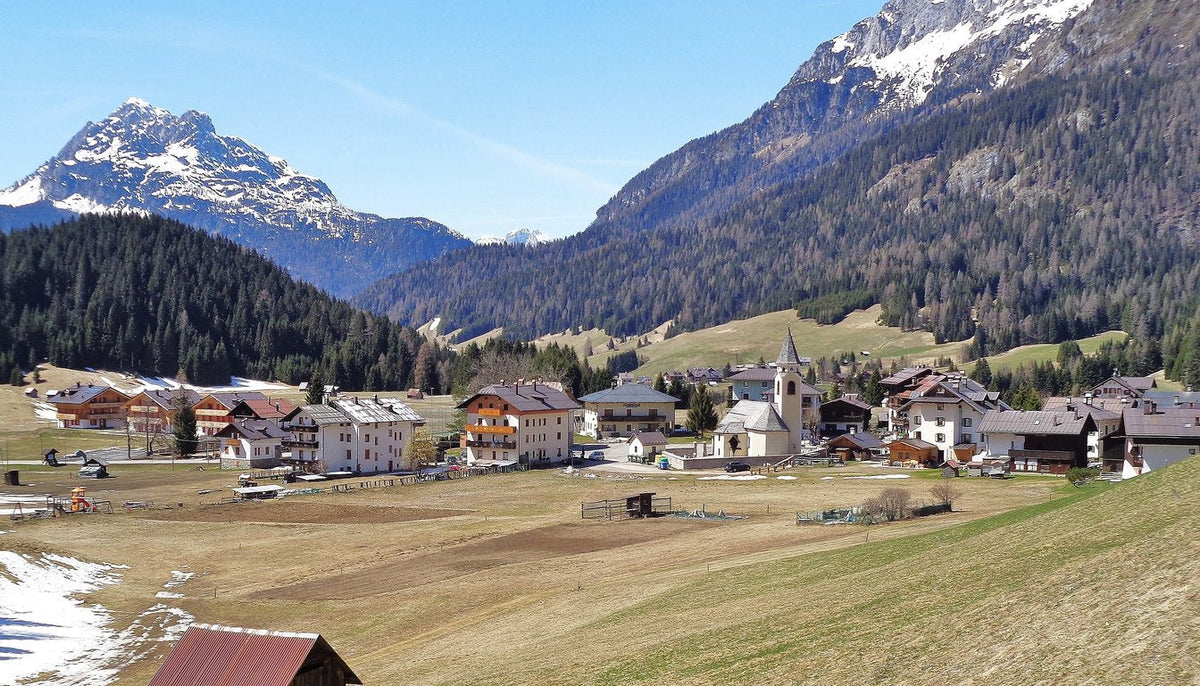
Set in the upper Piave Valley, at about 1,250 metres in the Eastern Dolomites on the border between Friuli Venezia Giulia, Veneto and Austria, Sappada (Plodn in the local dialect, Pladen in German) is one of the most distinctive Alpine destinations in Italy. It is a renowned summer and winter resort, crossed along its entire length by the Piave river, which rises within the municipal territory itself (Sappada Dolomiti, Neveitalia).
A village of about 1,300 inhabitants, Sappada is famous for three reasons: the timber architecture of its 15 hamlets, its German-rooted linguistic island, and a sporting vocation that has given Italy some of its greatest cross-country skiing champions. Since 2018 it has belonged to the Province of Udine, having historically been part of the Belluno area (Sappada Dolomiti, Neveitalia).
History and Origins
The founding legend
A legend tells that around the 10th century a few families fleeing the tyranny of the Counts of Heinfels left Villgraten, in East Tyrol, to take refuge in the Sappada valley, where they founded the first settlements. The fact that the Counts of Gorizia owned land in the area and encouraged the settlement of miners and farmers may lend support to the oral tradition (Sappada Dolomiti).
According to historians of language, the features of the dialect indicate that the settlers migrated from the Val Pusteria (Pustertal), in Eastern Tyrol (AlpiLinK). The first historical document mentioning the village dates to 1295-1296, but by then the village already had at least two or three centuries of history: the document itself speaks of a settlement existing “since time immemorial” (Sappada Dolomiti, AlpiLinK).
According to recent theories, the place name Sappada derives from Zepodn, the local name of Cima Sappada, perhaps the oldest settlement in the valley; the dialect name Plodn, on the other hand, would originate from the Latin name of the Piave river, Longa Plavis, the valley of the Piave (Sappada Dolomiti).
Miners, timber and a symbol
The very origins of the village are tied to mining: the municipal coat of arms shows a miner at work at the bottom of a mine, a figure in use since 1890 (Wikipedia). After securing possession of the valley, the first settlers devoted themselves to clearing forests and breaking new ground (Sappada Dolomiti). Over the centuries the local economy has rested on forestry, mountain farming, the timber trade and, since the twentieth century, tourism.
The nineteenth century, the wars and the move to Friuli
The annexation to the Kingdom of Italy after 1866 was welcomed unanimously in Sappada, but the early decades of the twentieth century were dramatic: during the First World War the Austrian attack forced the entire population to evacuate the village. In the Second World War the patriotic feelings of the Sappadini were called into question, amid suspicion that the population was pro-German because of the dialect it spoke (Sappada Dolomiti).
Isolated for centuries from Carnia and Cadore by distance and steep terrain, the community has jealously preserved its own German language and culture. Since 2018 Sappada has passed from the Province of Belluno to the Province of Udine, in Friuli Venezia Giulia (Sappada Dolomiti, Neveitalia).

Key Facts and Figures
| Item | Detail |
|---|---|
| Altitude | about 1,250 m a.s.l. (Neveitalia) |
| Population | about 1,300 inhabitants (Montagna.TV) |
| Location | upper Piave Valley, Carnic Alps/Eastern Dolomites, bordering Veneto and Austria |
| Layout | 15 hamlets (heivilan in the local dialect), set on the sunny side of the valley (Sappada Dolomiti) |
| Downhill slopes | about 20 km (Sappada Dolomiti) |
| Cross-country trails | 15-20 km in total (Sappada Dolomiti, DoveSciare) |
A curious record
With 10 Olympic medals relative to its population, Sappada holds an Italian record; it is the home of Silvio Fauner, Pietro Piller Cottrer and Lisa Vittozzi (Montagna.TV).
Culture of the Valley: Language and Traditions
The Sappadino dialect, a linguistic island
In Sappada people speak Sappadino or Plodarisch, a Bavarian-Tyrolean language classified as Austro-Bavarian or Pustertal-Carinthian, which has long drawn the attention of internationally renowned linguists and dialectologists (Sappada Dolomiti). It is a survival of Middle-Upper German brought by the first inhabitants in the Middle Ages, developed and preserved into the twentieth century while absorbing lexical influences from German, Friulian, Ladin and Italian (Plodn.info). The valley's high-altitude isolation has kept Sappadino particularly faithful to its Germanic roots (Plodn.info).
The dialect varies considerably between the individual hamlets, with sometimes notable differences between the central settlements and Cima Sappada (Plodn.info). From a linguistic classification standpoint, Sappadino belongs to the same group as the German dialects of Sauris and Timau, in the province of Udine, and Cimbrian (Wikipedia – Bavarian language).
Sappada is today one of the very rare places in Italy where three living languages coexist: Sappadino is spoken at home, Friulian is also studied at school, and Italian remains the official language (The Tuscany). In recent decades the dialect has been passed down less and less within families, but many young people show a renewed interest in the history and peculiarities of their village; fundamental have been the studies of scholars such as Professor Maria Hornung of Vienna, author of the first Sappadino dictionary (Plodn.info, AlpiLinK).
Festivals and rites of the year
Sappadino culture is marked by sacred and secular festivities tied to the cycle of the seasons and of Christianity: from New Year to Carnival, from Easter to the spring and summer processions, up to Christmas with the arrival of Saint Nicholas. Especially cherished is the annual pilgrimage on foot to the Sanctuary of Maria Luggau in Austria (Sappada Dolomiti).
With Austria, in fact, Sappada keeps a bond of religious affinity: on the third weekend of September the inhabitants set out along a path that crosses the mountains and the border, reaching after nine hours the Sanctuary of Our Lady of Sorrows for a religious twinning with Austrian worshippers (Montagna.net).
Among the summer events, the hamlets' festival, the Heivilanfescht, stands out, enlivening the old hamlets of Hoffe every July (Sappada Dolomiti Eventi).
Architecture: The Wooden Village
Sappadino architecture is Alpine in inspiration, dominated by rustic buildings and houses made entirely of wood that make up the village's architectural heritage. The houses are built with the ancient blockbau technique, using horizontally stacked beams notched together at the corners. The typical blockhaus houses can be found in Sappada Vecchia and Cima Sappada (Wikipedia).
Gastronomic and Culinary Traditions
Sappadino cuisine combines an Austro-Bavarian foundation with Venetian and Friulian influences, resulting in an authentic, genuine mountain table (Il Quaderno dei Luoghi). Typical dishes and products of the Dolomite tradition include:
- Canederli (bread and speck dumplings), barley and bean soups
- Sauerkraut with pork and mountain cured meats
- Gnocchi and first courses from the Venetian and Carnic tradition, thanks to the proximity of Comelico and Carnia
- Mushrooms and wild berries of the autumn season
- Alpine-pasture cheeses (malga cheeses) from the high-altitude meadows
- Desserts of the Austrian tradition: apple strudel and wild berry tarts
Local dining offers typical Dolomite dishes in an increasingly refined gastronomic setting (Visitsappada). The main food and wine event is Gustosa Sappada, a ten-day summer festival devoted to flavours, gastronomy and traditions: the 2025 edition ran from 19 to 27 July, while the 2026 edition is dedicated to flavours “Beyond the Border” (Borghi belli FVG, Sappada Dolomiti Eventi).
Winter Tourism
Sappada is a complete ski resort, with slopes suited to skiers of every level served by lifts, along with a rich offering of Nordic and alternative activities (Skiresort.info).
Alpine skiing
The resort has about 20 km of downhill slopes of varying difficulty, served by lifts, with the broad sunny terraces of the mountain huts serving as refreshment points (Visitsappada). The ski area is spread over two sides of the valley: the Pian dei Nidi chairlift climbs Monte Siera with its ski area, while a shuttle bus (free for skiers staying in the consortium's member accommodations) links Sappada 2000, on the other side, where the Miravalle and Hochbolt chairlifts lead to the more demanding red and black runs (DoveSciare).
Cross-country skiing: the champions' forge
Cross-country skiing is strongly promoted, with several loops totalling 15-20 kilometres, on which the greatest Italian champions on “narrow skis” trained: Maurilio De Zolt, Silvio Fauner and Pietro Piller Cottrer (Sappada Dolomiti, DoveSciare). The Nordic trails of Friuli are a true forge of champions, and Sappada holds the Italian record for Olympic medals per capita: 10 for every 1,300 inhabitants, with Lisa Vittozzi among its most decorated athletes (Montagna.TV).
Other winter activities
- Nevelandia, the large snow park for families and children, a reference point of winter Dolomite tourism
- Snowshoe hikes and winter hiking routes (Skiresort.info)
- Sledding and toboggan runs (Skiresort.info)
- Snowmobile: thrilling adventure excursions through the valley's forests (Visitsappada)
- Free ski bus connecting the two ski areas (DoveSciare)
Summer Tourism
In summer Sappada becomes an ideal base for active holidays, with the village's growing commitment to welcoming those in search of relaxation and clean air (Sappada Dolomiti). During the summer period (from mid-July to early September) a local tourist transport service is in operation (Sappada Dolomiti Eventi).
Trekking and walks
The valley's trails cover every level of difficulty: from easy walks along the Piave and between the hamlets, to treks toward the high-altitude lakes (Laghi d'Olbe, Laghetto), up to ascents of Carnic peaks such as Monte Siera and the border ridge. A classic destination is the route to the sources of the Piave, the river that rises right in the area (Sappada Dolomiti). There is also no shortage of historic linking hikes toward Austria, along the route of the pilgrimage to Maria Luggau (Montagna.net).
Mountain biking
The valley offers mountain bike itineraries on dirt roads and trails, with routes suited both to those new to off-road riding and to expert bikers, immersed in the woods and the views of the Eastern Dolomites. In collaboration with the neighbouring Comelico resorts, a network of cycling and mountain MTB routes is available (YesAlps).
Walks for everyone
The flat valley floor along the Piave and the lanes between the wooden hamlets are perfect for quiet, photogenic strolls, discovering Sappada Vecchia and Cima Sappada (Wikipedia).

Villages and Hamlets in the Surrounding Area
The village of Sappada stretches from east to west alongside the Piave river, divided into 15 hamlets, each with its own character (Sappada Dolomiti, Sappada Dolomiti):
- Sappada Vecchia: the historic heart, with the typical blockbau wooden houses (Wikipedia)
- Cima Sappada (Zepodn): perhaps the oldest settlement in the valley, with the most characteristic blockhaus houses and the most conservative dialect variant (Sappada Dolomiti, Wikipedia)
- Hoffe: the hamlet that hosts the summer hamlets' festival, the Heivilanfescht (Sappada Dolomiti Eventi)
- Lerpa: a hamlet with more recent homes (Wikipedia)
The nearby towns that complete the experience of the area:
- Forni Avoltri (Carnia): toward the Crepadon Pass, with the historic Malga Tuglia, a place rich in history and tradition nestled between Forni Avoltri and Sappada (Sappada Dolomiti Ristoranti)
- San Nicolò and Santo Stefano di Comelico (Veneto): the Comelico, with its Carnic-Dolomite architecture and Comelico food and wine offerings, reached via the Maura Pass; the Sappada-Comelico area shares mountain tourism and dining offerings (YesAlps)
- Villgraten/Maria Luggau (Austria): the legendary home village of the founders, reachable on foot with the September pilgrimage (Montagna.net)
Cultural Experiences Not to Miss
- A tour of the wooden hamlets between Sappada Vecchia and Cima Sappada, on foot or on guided visits
- The Gustosa Sappada festival, to taste the local culinary tradition (Borghi belli FVG)
- Heivilanfescht, the hamlets' festival in July (Sappada Dolomiti Eventi)
- Pilgrimage to Maria Luggau, for those seeking the most authentic historical and religious experience (Montagna.net)
- Sappadino Carnival (Vosencht), with its traditional masks among the festivities that mark the year (Sappada Dolomiti)
- Hike to the sources of the Piave, the natural symbol of the valley (Sappada Dolomiti)
Characteristic Restaurants and Hotels
Where to eat
- Ristorante Laite (Hoffe hamlet): the Kratter family has turned a typical mountain chalet into a gourmet address awarded by Gambero Rosso; elegant cuisine inspired by local traditions, with well-executed dishes and excellent ingredients (Gambero Rosso)
- Edelweiss Stube (in the centre, near Nevelandia): a typical venue open from breakfast to after-dinner, with a wide variety of dishes and an exclusive terrace overlooking the Dolomites, suited to any time of day (Soldeer Chalet Dolomiti, Sappada Dolomiti Ristoranti)
- Malga Tuglia (between Forni Avoltri and Sappada): a place rich in history and tradition, ideal for an alpine-pasture lunch (Sappada Dolomiti Ristoranti)
- Numerous other trattorias and farm stays offer traditional local mountain and Venetian cuisine, with genuine ingredients and seasonal recipes, both in Sappada and in nearby Comelico (YesAlps)
Where to stay
The accommodation offering is broad and integrated with the lifts: guests staying in member accommodations enjoy the free ski bus and discounts on ski passes (DoveSciare). Characteristic options include:
- Hotels and chalets in Alpine wooden style, often run by local families and set within the hamlets
- The Soldeer Chalet Dolomiti, a landmark chalet-hotel that also offers gourmet options for its guests (Soldeer Chalet Dolomiti)
- Guesthouses and B&Bs in the restored blockhaus houses of Sappada Vecchia and Cima Sappada, the most authentic way to experience the atmosphere of the village (Wikipedia)
- Farm stays and alpine huts on the slopes toward Forni Avoltri, for a holiday close to farming culture (Sappada Dolomiti Ristoranti)
Conclusions
Sappada is much more than a ski resort: it is an open-air village-museum, where a medieval German language survives a few dozen kilometres from the Adriatic Sea that “its” Piave will eventually reach; where the wooden houses tell of eight centuries of isolation and hard work; and where a community of barely 1,300 souls has produced Olympic champions and a table that blends Austria, Veneto and Friuli. Whether you come for the slopes of Monte Siera, the cross-country loops of the champions, the summer trails or Gustosa Sappada in July, the result is always the same: the authentic experience of a mountain that has not lost its soul.
Photo credits
- Cover: photo by Rollroboter, CC BY-SA 4.0, via Wikimedia Commons, cropped
- Image 1: photo by Sergio, CC BY-SA 2.0, via Wikimedia Commons
- Image 2: photo by Sebi1, public domain, via Wikimedia Commons

.jpg)
