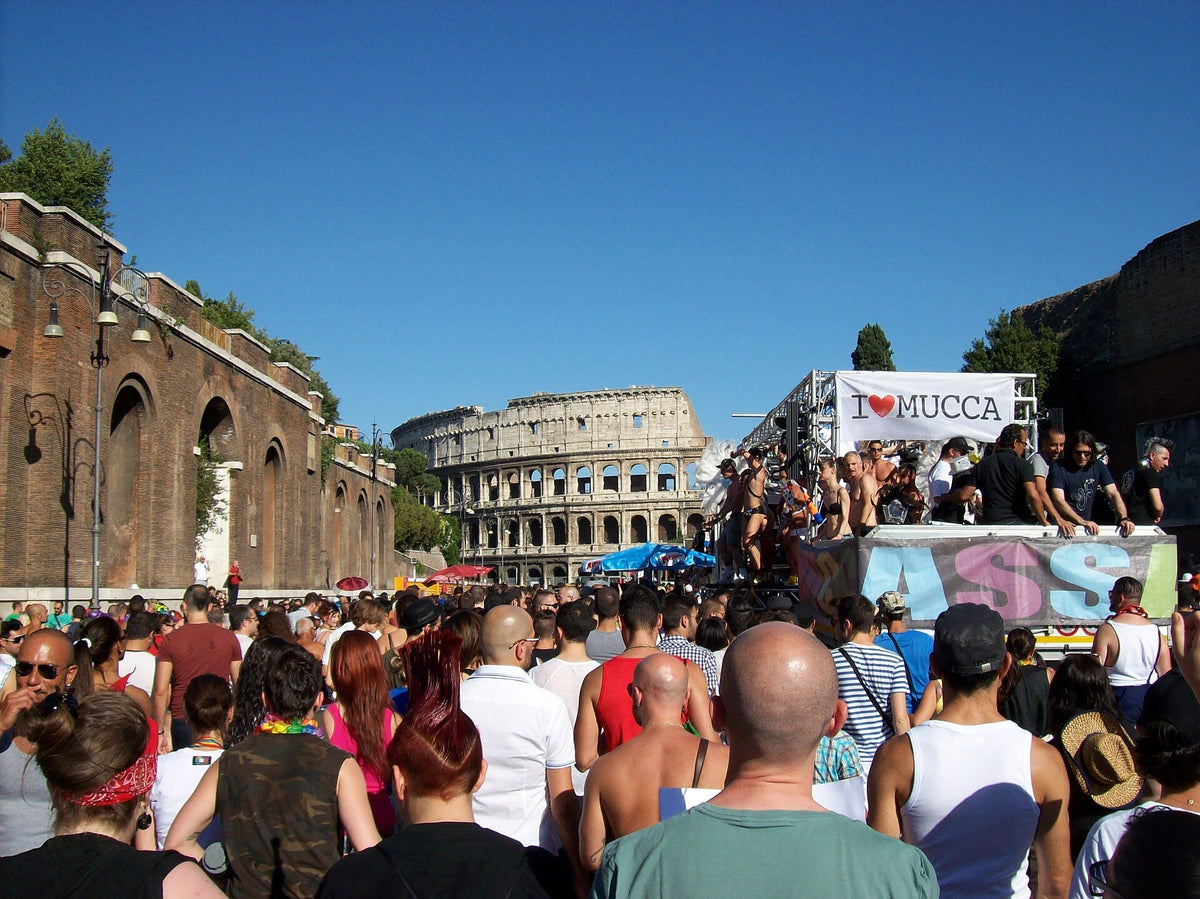
Italy's gay liberation movement was born, as elsewhere, on the wave of the 1968 protests and the early 1970s, but with features of its own: it developed in a Catholic country where the question of homosexuality had never been openly addressed by either politics or the law. Unlike Nazi Germany or other regimes that had explicitly codified homosexuality as a crime, Fascist Italy did not do so in the 1930 Rocco Code — not out of tolerance, but because the regime preferred to deny the very existence of the phenomenon, treating it as a disgrace to the “race” and to national virility that did not even deserve a mention in law.
This legal void did not translate into freedom: repression took other forms, from police-ordered internal exile to social marginalisation, from the silence of the mainstream press to medical pathologisation. It was against this backdrop of enforced invisibility that, between the late 1960s and the early 1980s, a group of intellectuals, activists and ordinary citizens built, often at great personal cost, the foundations of today's Italian LGBT+ movement. This article traces its main milestones, its protagonists and the legacy that still shapes public debate on civil rights in Italy.
Methodological note
Why “pioneers”
The term refers here to the people and organisations who, for the first time in Italy, made visible and organised a struggle that had until then been fought in solitude and secrecy: not an exhaustive list, but a selection of the figures and events historians today consider foundational.
The long silence: from Fascist internal exile to the postwar years
During the two decades of Fascist rule, homosexuality was never made a standalone crime under the Rocco Code, but this did not prevent systematic persecution through the administrative tool of police-ordered internal exile (confino), which required neither a trial nor proof of any specific offence. The best-known case is that of the island of San Domino, in the Tremiti archipelago: from 1939, some three hundred men, most of them from the area around Catania, were sent there after being reported by local authorities as “pederasts” or “inverts”. Paradoxically, isolated from the rest of society, these men formed what historians have called the first de facto homosexual community in Italian history, dissolved only in 1940 when the facility was repurposed to intern foreign nationals at the start of the war.
After the war, despite the new republican Constitution and the end of the regime, silence around homosexuality remained almost total for more than twenty years. Homosexual people continued to live their relationships in a secrecy imposed by social shame, fear of blackmail and job loss, with no cultural, associative or political point of reference whatsoever. It would take the protest climate of the late 1960s to break that silence.

The Braibanti case: a trial that shook the country
The first event to bring the question of homosexuality to the centre of Italian public debate was, paradoxically, a criminal trial. Aldo Braibanti, an intellectual, playwright and former partisan, was reported to police in 1964 by the father of a young man, Giovanni Sanfratello, with whom he had had a relationship. The charge was “plagio” (“mental subjugation”), an offence under Article 603 of the Rocco Code that punished anyone who “subjects a person to their own power”, reducing them to a state of total submission: a vague offence, introduced under Fascism, that found its only application in the history of republican Italy in the Braibanti trial.
On 14 July 1968, at the end of a trial that had lasted four years, the Rome Assize Court sentenced Braibanti to nine years in prison, reduced to four on appeal; he would serve two, with the remainder pardoned in recognition of his record as a wartime partisan. Although the verdict never formally mentioned homosexuality, to public opinion and observers at the time it was clear that what was really on trial was the defendant's sexual orientation rather than any genuine offence. The trial mobilised much of the Italian intellectual world: among others, Alberto Moravia, Pier Paolo Pasolini, Elsa Morante, Umberto Eco, Dacia Maraini and film director Marco Bellocchio publicly took Braibanti's side, while Marco Pannella's Radical Party was the only political force to take up the case.
Article 603 on “plagio” was declared unconstitutional by Italy's Constitutional Court only in 1981, and Braibanti's conviction was struck from the record the following year: an extremely long road to redress, which shows how deeply rooted, even decades after the war, was the state's will to repress homosexuality through indirect means, in the absence of any explicit law.
In depth
Article 603 of the Rocco Code
The offence of “plagio” punished with five to fifteen years in prison anyone who reduced another person to a state of total psychological subjugation. Introduced under Fascism, the Braibanti case remains its only application in the judicial history of republican Italy before its repeal for unconstitutionality in 1981.
1971: FUORI! is born, the first organised movement
In the spring of 1971, FUORI! (Fronte Unitario Omosessuale Rivoluzionario Italiano — United Italian Homosexual Revolutionary Front) was founded in Turin, the first homosexual movement organised on a national scale in Italian history. Its founder and leading figure was Angelo Pezzana, a Turin bookseller and openly gay man, who brought together activists already active in Milan, Rome, Turin and Padua. That same year, the Fronte di Liberazione Omosessuale, founded in Rome in August 1971 by Mariasilvia Spolato — the first woman in Italy to publicly come out as a lesbian on television — merged into FUORI!.
The chosen name was a clear play on words between the Italian acronym and the English expression “coming out”, and explicitly echoed the French FHAR (Front Homosexuel d'Action Révolutionnaire) and the Anglo-American Gay Liberation Front. In December 1971 the zero issue of the eponymous magazine came out, distributed in around a thousand copies across several Italian cities, with contributors including writer and translator Fernanda Pivano. Initially Marxist in outlook, FUORI! read sexual discrimination as part of the broader class struggle, laying the groundwork for a collective identity built, for the first time in Italy, on public claim-making rather than shame.
1972: Sanremo and the first public demonstration
The movement's public debut came in April 1972 in Sanremo, where the Italian Centre for Sexology (CIS) held an international congress devoted, among other things, to “cures” for homosexuality, including hormonal treatments and electroshock therapy. A group of FUORI! activists — including Angelo Pezzana, Alfredo Cohen, French feminist Françoise d'Eaubonne and Mario Mieli, at the time a member of London's Gay Liberation Front — gathered outside the municipal Casino, where the congress was held, with placards and chants, going as far as addressing the proceedings directly from the speakers' table. It was the first time in Italy that a group of homosexual people demonstrated publicly and collectively for their rights, reversing the relationship between those who had until then been passive objects of clinical study and those now claiming the right to speak for themselves.
Historical context
The Sanremo congress
The 1972 International Congress of Sexology brought together psychiatrists and sexologists around a theme then widespread even in scientific circles: the “cure” of homosexuality as a psychiatric deviance. The Sanremo protest is generally regarded as the first public action of the homosexual liberation movement in Italy.
Mario Mieli and radical homosexual critique
Among the protagonists of that era, none left an intellectual mark comparable to Mario Mieli's. Born in Milan in 1952, Mieli first came into contact with the gay movement in London, where he joined the Gay Liberation Front, before returning to Italy and becoming one of FUORI!'s most radical and visible voices. In 1977 he published “Elementi di critica omosessuale” (“Elements of Homosexual Critique”), an essay weaving together Marxism, psychoanalysis and gender theory to argue a then-provocative thesis: that bisexuality and fluid desire were a natural condition, repressed by capitalist and patriarchal society through the imposition of compulsory heterosexuality as a norm. The book, today considered a classic of Italian queer thought, brought him both fame and isolation, thanks to a writing style as learned as it was deliberately provocative, matched by public performances in women's clothing.
Mieli gradually distanced himself from FUORI! after the movement's alignment with the Radical Party, decided at the extraordinary congress in Milan in November 1974: part of the membership, more Marxist in outlook and less inclined toward an alliance with a secular liberal party, left to form independent collectives, including the Milan Homosexual Collective and, in Rome, the Narciso Collective. Mario Mieli died by suicide in Milan on 12 March 1983, at just thirty years of age: his death profoundly marked the movement, which named one of its most important organisations after him only a few months later.
Splits, new groups and the Giarre tragedy
FUORI!'s later years in the 1970s were marked by internal tensions, particularly after its affiliation with the Radical Party in 1974, which broadened the movement's political visibility but, for some members, diluted its original revolutionary charge. On 14 January 1977, Palermo hosted what is regarded as the first homosexual pride march in Italy; FUORI! formally dissolved in January 1982, at the end of its last national congress in Vico Equense, after eleven years of activity and more than sixty issues of its magazine.
A qualitative leap in the movement's territorial spread came, tragically, in the wake of a violent crime. On 31 October 1980, the bodies of Giorgio Giammona, twenty-five, and Antonio Galatola, fifteen, a gay couple from Giarre, near Catania, who had gone missing weeks earlier, were found dead, holding hands, each shot once in the head. The double murder, which became known as the “Giarre crime”, appears to have been motivated by their families' refusal to accept their sexual orientation. The news sparked an unprecedented mobilisation: barely six weeks later, on 9 December 1980, the first ARCI Gay club was founded in Palermo, on the initiative of Father Marco Bisceglia, an openly gay priest close to Catholic grassroots communities, together with the young conscientious objector Nichi Vendola and other activists including Massimo Milani and Gino Campanella. Around the same time, Palermo also saw the birth of “Le Papesse”, the first Sicilian lesbian collective.
Il Cassero, the Mario Mieli Circle and the birth of Arcigay
On 28 June 1982 the city of Bologna granted management of the Cassero di Porta Saragozza, an old city gate, to the Circolo Culturale 28 Giugno: the first case in Italy of a public authority formally recognising a space for a homosexual association. “Il Cassero” would go on to become the historic home of the Bolognese and national LGBT+ movement.
In Rome, in April 1983, the merger of FUORI!'s local branch with the Narciso Collective gave rise to the Circolo di Cultura Omosessuale, which its founders decided to name after Mario Mieli, who had died only weeks earlier: the Mario Mieli Circle would become, in the decades that followed, one of Italy's largest LGBT+ organisations, organiser of the Rome Pride from 1994 onward and, in 2000, of the first World Pride in history.
The national organisational turning point came in March 1985: at the Bologna assembly of 2 and 3 March, almost every gay club then existing in Italy agreed to form a unified structure, giving rise to Arcigay as an autonomous national association, headquartered at the Cassero. Beppe Ramina was elected its first president and Franco Grillini its first national secretary: it was Grillini, a Bologna-based activist and later a member of parliament, who would go on to lead the association for much of the following two decades, making it the country's largest LGBT+ organisation.

Key figures and organisations
| Name / Organisation | Role | Main contribution |
|---|---|---|
| Aldo Braibanti | Intellectual, playwright | Unwitting symbol of the judicial persecution of homosexuality (1968 trial) |
| Angelo Pezzana | Founder of FUORI! | Founded Italy's first nationally organised homosexual movement in Turin in 1971 |
| Mariasilvia Spolato | Activist, founder of the FLO | First woman in Italy to publicly come out as a lesbian on television (1972) |
| Mario Mieli | Intellectual, activist | Author of “Elementi di critica omosessuale” (1977), the movement's most radical voice |
| Father Marco Bisceglia | Priest, Arcigay co-founder | Helped found the first ARCI Gay club in Palermo in 1980, after the Giarre murders |
| Nichi Vendola | Arcigay Palermo co-founder | Among the founders of the first ARCI Gay club; later an MP and regional president |
| Franco Grillini | First national secretary of Arcigay | Led Arcigay from 1985 for much of two decades, later a member of parliament |
| FUORI! | Turin, 1971-1982 | Italy's first national homosexual movement and magazine, Marxist in outlook |
| Il Cassero | Bologna, from 1982 | First publicly recognised space granted to a homosexual association in Italy |
| Mario Mieli Circle | Rome, from 1983 | Organiser of the Rome Pride from 1994 and of the first World Pride in 2000 |
| Arcigay | National, from 1985 | Italy's first and largest LGBT+ federation, historic headquarters in Bologna |
The AIDS emergency and the movement's coming of age
The second half of the 1980s marked a dramatic turning point for the movement, hit hard by the spread of HIV/AIDS in a social climate often marked by stigma and misinformation. Organisations founded in the previous decade, chiefly Arcigay and the Mario Mieli Circle, found themselves on the front line, also becoming public-health actors: they set up helplines and prevention campaigns and, from 1989, the first home-care services for non-self-sufficient HIV-positive people, at a time when health institutions struggled to fill the gap. This phase forced the movement into a new organisational maturity, joining for the first time the demand for civil rights with the running of social and health services on a national scale.
From the first Prides to civil unions
From 1994 the Mario Mieli Circle has organised the annual Rome Pride, which in 2000, the Jubilee year, hosted the first World Pride in history, not without tension with the Church hierarchy. In 2007 the movement responded with a large demonstration in Rome, under the slogan “Equality, Dignity, Secularism!”, to the concurrent conservative Family Day rally against the legal recognition of unmarried couples. In 2011 Rome hosted Europride, organised together with Arcigay, MIT, Famiglie Arcobaleno and Agedo.
The most significant legislative milestone came in May 2016, when Parliament passed Law No. 76, known as the “Cirinnà law” after its lead sponsor, Senator Monica Cirinnà, introducing civil unions for same-sex couples in Italy for the first time. The text, the result of lengthy parliamentary negotiation, grants property and inheritance rights largely equivalent to marriage, but, after the removal of the so-called stepchild adoption provision, stops short of full legal recognition of parenthood for same-sex couples — a compromise that still fuels political debate today.
In depth
What the Cirinnà law (76/2016) does
It establishes civil unions between people of the same sex, granting property, inheritance, social-security and welfare rights that largely overlap with civil marriage. It is not formally equivalent to marriage and, in the version passed, contains no provisions on adopting a partner's child (stepchild adoption), which was removed during the parliamentary process.
Legacy and open challenges
More than fifty years after FUORI! was founded, the movement those pioneers started has profoundly changed Italian society: from the de facto decriminalisation already in place after the war, to the removal of homosexuality from diagnostic manuals, to the 2016 civil unions law, to the gradual — if uneven — social and media visibility of LGBT+ people. Organisations such as Arcigay, today a federation with dozens of local chapters and hundreds of thousands of members over its history, and the Mario Mieli Circle continue to operate on multiple fronts: from helplines and health-prevention services to campaigns against homophobia, biphobia and transphobia, from education in schools to organising Pride events in dozens of Italian cities.
Significant issues nonetheless remain open compared with other European countries: Italy does not recognise equal marriage, retains legal uncertainty over parenthood for same-sex couples, and has introduced restrictions on surrogacy even when legally performed abroad — topics on which political and social debate remains heated and polarised.
“From a trial for “mental subjugation” held in a courtroom to a law of the state: the history of Italy's movement is the history of people who turned an imposed invisibility into a collective voice.” — Editorial team
Conclusions
The history of gay liberation in Italy is not the story of a single founding event, but of a sequence of successive ruptures: an unjust trial that becomes a national scandal, a group of activists who occupy a public space in Sanremo, a book that overturns common sense, a murder that becomes an organisational spark, a municipal space granted in Bologna, an assembly that unites dozens of scattered clubs. It is from the sum of these steps — often paid for dearly by the individuals involved — that today's Italian LGBT+ movement was born, the direct heir of those pioneers' core insight: that dignity, to be recognised, first had to be publicly claimed.
Sources and further reading
- Gianfranco Goretti, Tommaso Giartosio, La città e l'isola. Omosessuali al confino nell'Italia fascista, Donzelli, Rome 2006
- Gabriele Ferluga, Il processo Braibanti, Aguaplano, Perugia 2013
- Mario Mieli, Elementi di critica omosessuale, Feltrinelli, Milan 1977 (new ed. 2017)
- Museo Diffuso di Torino, exhibition and volume “FUORI! 1971-2021”, Fondazione Sandro Penna
- Historical archive and official website of Arcigay (arcigay.it)
- Historical archive and official website of the Mario Mieli Circle (mariomieli.org)
- Documentation centre of the Cassero LGBTI Center, Bologna (centrodocumentazionecassero.it)
- Text of Law No. 76 of 20 May 2016 (“Cirinnà law”), Official Gazette of the Italian Republic
This article is intended for informational and educational purposes; for specialist research, please refer to the historiographical and archival sources cited above.
Photo credits
- Cover: photo by Blackcat, CC BY-SA 3.0, via Wikimedia Commons
- Image 1: photo by Giorgio Galeotti, CC BY 4.0, via Wikimedia Commons
- Image 2: photo by Carlo Pelagalli, CC BY-SA 3.0, via Wikimedia Commons


