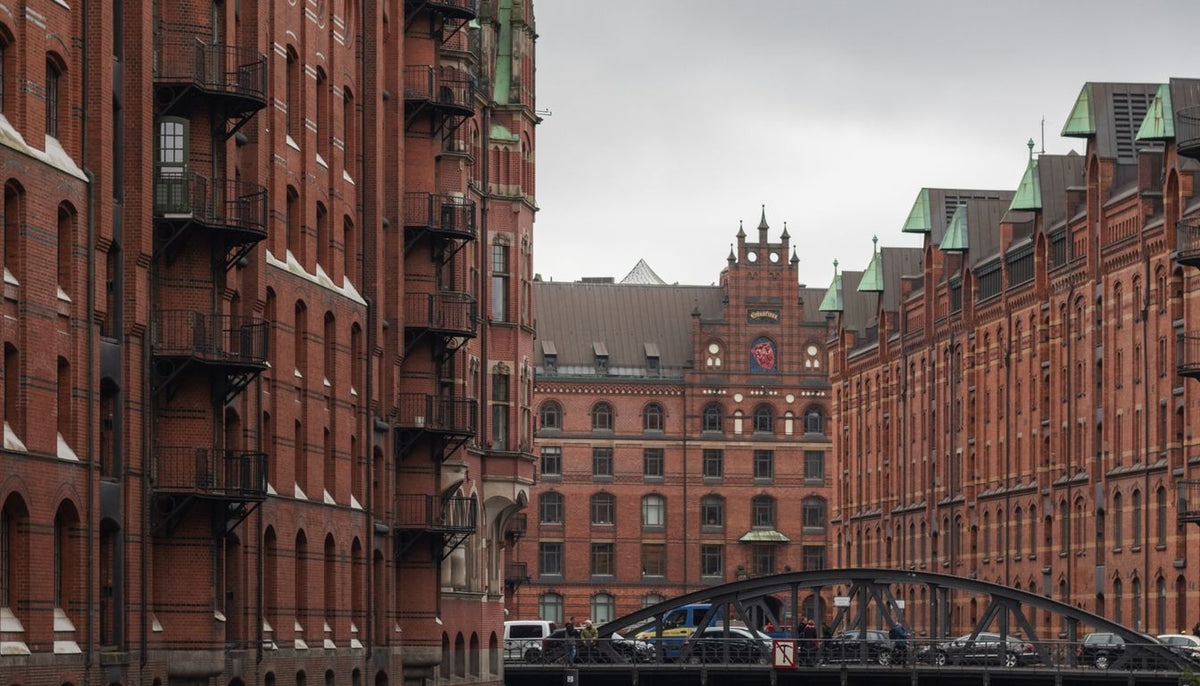
A thousand years of port history, canals, red brick and one of Northern Europe's liveliest cultural scenes — LGBT+ life included.
Historical origins and development
Hamburg, officially the Free and Hanseatic City of Hamburg (Freie und Hansestadt Hamburg), traces its roots back a thousand years — through fires, floods, wars and an unshakeable commercial vocation that made it one of Europe's most important ports.
Ancient roots
The area's first recorded name was Treva, mentioned by Claudius Ptolemy in the 2nd century AD. The city's actual founding dates to 808 AD, when Emperor Charlemagne ordered the construction of a castle, the Hammaburg, on rocky ground between the Alster and Elbe rivers, as a defense against Slavic raids.
-
834
Hamburg becomes the seat of a diocese thanks to Bishop Ansgar, the "Apostle of the North".
-
845
A fleet of 600 Viking ships sails up the Elbe and destroys the city, then home to around 500 people.
-
1030 and 1201-1214
The city is raided and occupied by King Mieszko II of Poland and King Valdemar II of Denmark.
The medieval age and the Hanseatic League
Hamburg grows into a key port between the North Sea and the Baltic, becoming one of Northern Europe's most important trading centers.
-
1189
Emperor Frederick Barbarossa grants Hamburg the status of Free Imperial City, with tax privileges for trade along the Elbe.
-
1241
The alliance with Lübeck marks the birth of the Hanseatic League.
-
1266
A contract with Henry III of England allows Hamburg's merchants to set up a trading guild in London — the first recorded use of the term "Hanse".
-
1270
Jordan von Boitzenburg writes the Ordeelbook, the first written description of civil, criminal and procedural law for a German city in the German language.
-
1356
The first Matthiae-Mahl ceremonial banquet is held; it continues today as the world's oldest ceremonial meal.
The modern age and its catastrophes
-
1529
Hamburg embraces Lutheranism and takes in Reformed refugees from the Netherlands and France.
-
1640-1680
The Neustadt, a new fortified district, is built to defend against the Thirty Years' War.
-
1806
With the dissolution of the Holy Roman Empire, Hamburg becomes a sovereign state.
-
1811-1814
Napoleon annexes the city to the First French Empire; it is liberated by Russian troops in 1814.
-
1842
The Great Fire devastates a quarter of the city: 51 dead, 20,000 left homeless. Reconstruction takes over 40 years.
-
1892
A cholera epidemic kills 8,600 people.
The 20th century: war, destruction and rebirth
-
1933-1945
Under the Third Reich, Hamburg is a Gau (administrative region) of Nazi Germany.
-
1943
Allied bombing during Operation Gomorrah creates a firestorm that devastates much of the city: at least 42,600 civilians killed, roughly one million evacuated.
-
1945
The city surrenders to British forces on May 3rd.
-
1962
The North Sea flood submerges a fifth of the city: over 300 dead.
-
1990
After German reunification, Hamburg reclaims its role as a major European trade and port hub.

Facts and figures (2026)
- Population (2026 estimate)
- 1.92 M
- Metropolitan area
- 5.1 M
- City area
- 755 km²
- Population density
- 6,010/km²
- Port by cargo traffic
- #1 in DE
- Bridges (more than Venice + Amsterdam combined)
- 2,500
Hamburg has more churches taller than 100 meters — five — than any other city in the world. The historic local language is Low German (a dialect), and the climate is oceanic: mild winters, cool summers, rain spread throughout the year.
Demographics and communities
By religion: 27% Evangelical Lutheran, 10.7% Roman Catholic, 55% unaffiliated. Among the foreign communities, the Portuguese stand out (30,000, with the Portugiesenviertel district) and the Afghans (50,000 — Europe's largest Afghan community), alongside Poles, Turks, Russians and Italians.
Landmarks and historic attractions
Rathaus — Hamburg City Hall
Rathausmarkt 1, 20095 Hamburg
Built between 1886 and 1897 in Neo-Renaissance style, it houses the city government. Its copper dome, 112 meters tall, is one of the city's landmarks. Guided tours are available in several languages.
St. Michael's Church (St. Michaelis)
Englische Planke 1, 20459 Hamburg
Hamburg's largest Baroque church, with a 132-meter tower — the tallest in the city — offering panoramic views. Open daily, 9am-9pm; tower access €7.
Chilehaus
Fischertwiete 2, 20095 Hamburg
A masterpiece of Expressionist architecture (1922-1924), designed by Fritz Höger. Its shape evokes a ship's prow.
Speicherstadt and Kontorhausviertel
Warehouse district
A UNESCO World Heritage Site since 2015: the largest brick warehouse complex in the world. Home to Miniatur Wunderland, the largest model railway museum in the world (Kehrwieder 2/Block D — open 9:30am-6pm, until 8pm in summer; €20-€25).
Elbphilharmonie
Platz der Deutschen Einheit 4, 20457 Hamburg
A contemporary architectural masterpiece (2017) by Herzog & de Meuron, with a concert hall considered one of the best in the world for acoustics. The panoramic plaza is open daily 9am-11pm, free but booking is recommended.
Port of Hamburg (HafenCity)
Germany's largest port and Europe's third-largest. Elbe river cruises (€15-€30) offer views of the port and city from the water.
Hammaburg — the original castle
Hammaburgplatz (historic site)
The city's first permanent settlement, built by order of Charlemagne in 808 AD.
Laeiszhalle
Jahnstraße 4, 22767 Hamburg
One of Europe's most celebrated concert halls, home to the Hamburg Philharmonic Orchestra.
Hamburg Bunker
Feldstraße 66, 20357 Hamburg
A World War II bunker turned into an interactive museum on the city's history.
Planten un Blomen
Neuer Jungfernstieg, 20354 Hamburg
A public park with themed gardens, fountains and ponds; it hosts open-air concerts in summer.

Cultural life: art, music and theatre
Museums and galleries
| Museum | Address | Notes | Price |
|---|---|---|---|
| Kunsthalle Hamburg | Glockengießerwall 5 | Works from the 14th to the 21st century, founded 1869 | €14 |
| Hamburger Kunstverein | Klosterwall 23 | Contemporary art, temporary exhibitions | €8-€12 |
| Museum für Kunst und Gewerbe | Steintorplatz | Applied arts, design and fashion | €12 |
| Deichtorhallen | Deichtorstraße 1-2 | Modern art in a former warehouse | €12 |
| Internationales Maritimes Museum | Kaispeicher B | 9 floors on the history of seafaring | €13 |
Theatres and concert halls
- Elbphilharmonie
- Hamburg State Opera
- Laeiszhalle
- Thalia Theater (1843)
- Deutsches Schauspielhaus
- Stage Theater an der Elbe
Music and festivals
- Reeperbahn Festival (September) — one of Europe's largest music festivals.
- Hamburg International Music Festival — world-class classical music.
- MS Dockville (August) — contemporary art and music.
- Schlagermove (July) — German pop, one million visitors.
- Hamburg Jazz Festival (May) — jazz and improvisation.
LGBT+ life in Hamburg
Hamburg is one of Germany's most gay-friendly cities. The St. Georg district is the heart of gay life, while St. Pauli offers a wilder nightlife.
Neighborhoods
St. Georg
the city's "gayborhood": bars, clubs, restaurants and LGBT+ shops line the pedestrian street Lange Reihe, decked with rainbow flags and hosting events year-round.
St. Pauli (Reeperbahn)
the red-light district, home to edgier, more nocturnal gay clubs.
Bars and pubs
| Venue | Address | Description |
|---|---|---|
| Le Club | Lange Reihe 22 | Historic gay bar since 1978, '80s-'90s music |
| Männerschwarm | Lange Reihe 85 | Bar for men, themed nights and karaoke |
| Pulse | Lange Reihe 72 | Modern bar with cocktails and DJ sets |
| Café Knuth | Lange Reihe 34 | Gay-friendly café, breakfast and brunch |
| L'Chaim | Lange Reihe 50 | Bar and restaurant with Jewish and German cuisine |
| Zucker & Zimt | Lange Reihe 134 | Café and bar with pastries and hot drinks |
Clubs and nightlife
| Venue | Address | Description |
|---|---|---|
| Club 136° | Reeperbahn 136 | House, techno and pop |
| WunderBar | Reeperbahn 137 | Drag nights, cabaret and karaoke |
| Klubhaus St. Pauli | Spielbudenplatz 19 | LGBT+ nights and themed parties |
| Nachtasyl | Große Freiheit 39 | Alternative club, queer nights |
| Pride Club | Davidstraße 40 | Dance and hip-hop music |
Events and festivals
- Hamburg Pride / CSD Hamburg (July-August) — one of Germany's largest Pride parades.
- Fetish Week (September).
- Queer Film Festival (October).
- Winter Pride (December) — LGBT+ Christmas markets and parties.
Accommodation and organizations
Gay-friendly places to stay include Hotel Rubin (Steindamm 6), A&O Hamburg Hauptbahnhof (Amsinckstraße 2-10) and The George Hotel (Barcasstraße 10). For support and information: LSVD (Kirchweg 68), AIDS-Hilfe Hamburg (Lange Reihe 81), and the Queer-Hamburg portal.
Culinary traditions
Hamburg's cuisine reflects its maritime history and Northern European traditions: fish, potatoes, salted meat, and one iconic swirl-shaped pastry.
Signature dishes
Franzbrötchen
A spiral pastry with cinnamon and sugar, the city's sweet emblem. Try it at Café Knuth (Lange Reihe 34, €2.50) or Franz & Friends (Neuer Pferdemarkt 13, €3).
Fischbrötchen
A sandwich with fresh or marinated fish, onions, remoulade and sour cream. Try the stand Fischbrötchen bei Brück (Reeperbahn, €4-€6) or Fischereihafen Restaurant (€8-€12).
Labskaus
A hearty dish of corned beef, potatoes, beetroot and onions, served with a fried egg, herring and pickles — traditional sailors' food. Old Commercial Room (€12-€15) or Zur Ritze (€10-€14).
Currywurst
Sliced sausage with spiced ketchup and curry powder. Curry & Chili (Schanzenviertel, €3.50-€5) or Currywurst bei Brück (Reeperbahn, €4).
Rote Grütze
A dessert of mixed berries cooked in syrup, served with cream or vanilla ice cream. Café Paris (€6-€8) or Café Elbgold (€7).
Aalsuppe and Kartoffelsuppe
The traditional eel soup with vegetables, prunes and apples (Old Commercial Room, €10-€14), and a creamy potato soup with carrots, celery and sausage (Gasthaus Alt Hamburg, €8-€12).
Pannfisch
Breaded fish (usually cod or haddock) with potatoes and butter sauce. Fischereihafen Restaurant, €18-€25.
Where to eat
Traditional German: Old Commercial Room, Zur Ritze, Gasthaus Alt Hamburg, Braugasthaus Altes Mädchen, Fischereihafen Restaurant.
Fine international dining: NENI Hamburg (Middle Eastern), Haerlin and The Table by Kevin Fehling (3 Michelin stars, French and modern cuisine), Tide (1 Michelin star, Nordic cuisine), Bullerei (modern German cuisine, by Tim Mälzer).
Italian: Trattoria da Giovanni, A MANO (Sicilian), L'Olivo (Tuscan).
Asian: Tide (Asian-Nordic fusion), Cô Cô Bánh Mì Deli (Vietnamese), Umami (Japanese).
Between brick warehouses, glass concert halls and herring sandwiches, Hamburg is still a city best told on foot, along its canals.
Photo credits
- Cover: photo by Niklas Jeromin, via Pexels
- Image 1: photo by Wolfgang Weiser, via Pexels
- Image 2: photo by Jasmin Kaemmerer, via Pexels